Forex bid, ask and midpoint in a strategy test
Identify the price side before interpreting a rule, spread charge or completed cash result.
A chart observation is not an order price
A research chart can use a midpoint or another feed convention, while the selected account needs its actual quote side and execution. Name the source rather than treating every displayed price as executable. The new lens declares entry and exit bid/ask snapshots manually and assumes long entry ask/exit bid or short entry bid/exit ask. That is a teaching convention, not a broker execution model. It contains no sequence, latency, available quantity or order acknowledgement. A valid input therefore completes an equation without authenticating the underlying quote, establishing tradeability or promising the chosen amount would fill.
The unchanged midpoint exercise has a negative price comparison
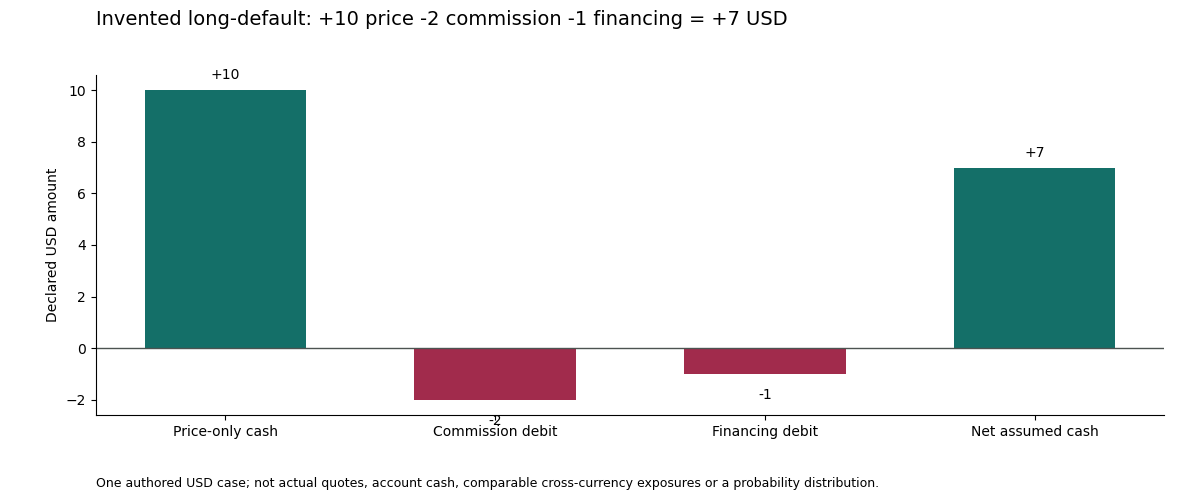
In the authored flat-quote case, entry and exit are both 1.0998 bid and 1.1000 ask. The long assumption buys at 1.1000 and values an exit at 1.0998, giving negative 2 USD on 10,000 base units. An unchanged midpoint does not make that side-based comparison zero. Two USD commission and negative one financing produce negative 5 net. These are invented amounts, not an observed spread or account. No extra spread is subtracted: the chosen side prices already determine the price-only component. The diagnostics identify entered gaps rather than an additional cash levy.
An actual study must retain its observation and fill conventions
If the data contain only midpoints, record the chosen execution proxy and its missing quote evidence. If actual fill prices already include friction, another generic spread addition may duplicate it. The original protocol keeps that decision explicit; the new price-side exercise illustrates why it matters. A bar high or low is also not an authenticated fill for an intended quantity. Preserve product identity, receiving clocks and the established hypothetical research-fill window when doing a real study. Do not choose whichever available convention makes one preferred strategy look better after the outcome is known.
Price-side correctness does not select the entry model
Costs and executable differences can validate or reject a frozen experiment, but must not silently rank the canonical raw causal entry definitions. Entry identity, one predeclared exit, independent evaluation and complete selection history remain separate requirements. The tutorial does not connect an account or reproduce a profitable FX rule. Its seven amount cases and three setup cards are different authored objects, not a combined price series. Official quote and slippage documentation support mechanism questions only. Actual account records, licensed data and operational certification are not generated by loading the example.
Filled fictional forex case
The flat-midpoint example ends at negative 5 USD under explicit long-side assumptions and costs. It is not a measured spread distribution, tail estimate or actual trade. Its diagnostic side gaps are not charged twice. The finished finding concerns a declared price basis; authenticated quotes, fills and independent strategy economics remain absent.
| Object | Record | Bounded finding |
|---|---|---|
| Entry/exit snapshots | 1.0998 / 1.1000 | Invented same midpoint |
| Long assumed sides | 1.1000 to 1.0998 | -2 USD price-only |
| Commission/financing | 2 / -1 USD | -5 USD net |
Primary references and scope
Source checks: 13-14 October 2026. Official mechanism descriptions are not this desk's paid-account test, independently captured fills or vendor-return audit.